
Cold Outreach Is Dead. Here Is What Replaced It.
Cold outreach produces predictable results, and the three approaches that actually generate partnerships solve a relationship problem rather than a volume problem.
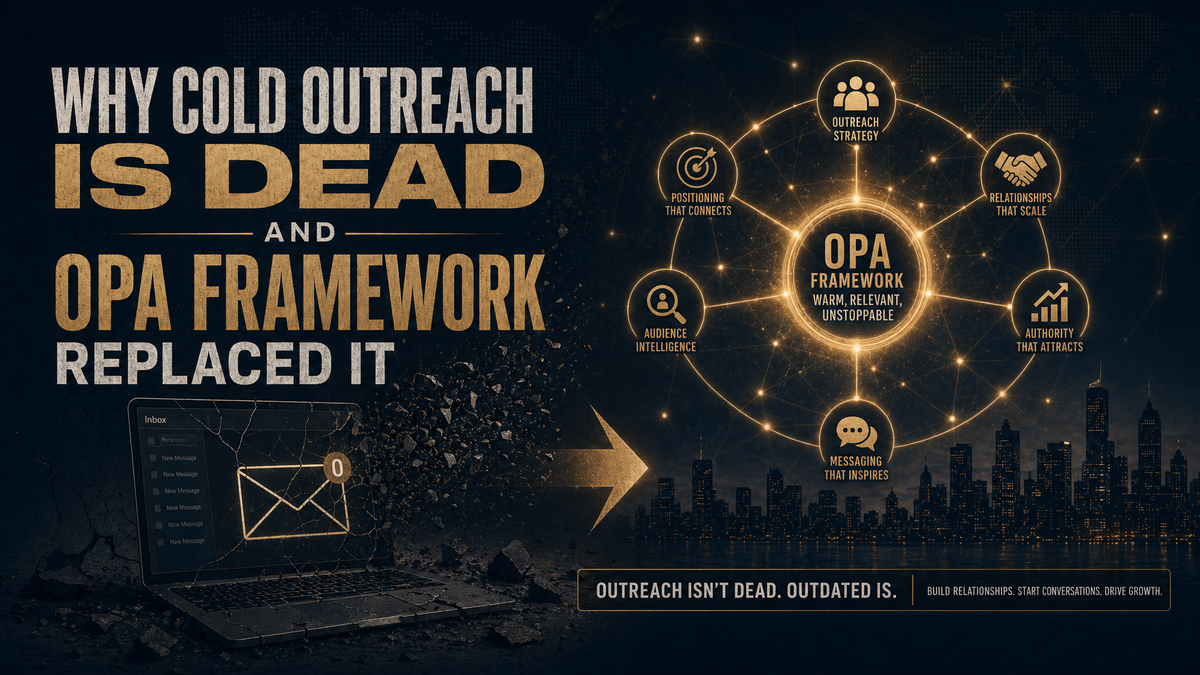
The 2014 Playbook Is Still Running in 2026
Founders are still sending 200 cold DMs a week in 2026. They are running the 2014 playbook in a market that has completely changed, and they are measuring their effort by volume because volume is the only metric that feels like progress when nothing is converting.
The cold outreach approach made sense in a specific historical context. Inboxes were less crowded. Buyers carried lower baseline skepticism. The novelty of a personalized message actually felt personal. None of those conditions exist anymore. The average professional receives hundreds of unsolicited messages per week, and the filtering mechanisms, both psychological and algorithmic, have become correspondingly more aggressive in response.
Founders who have not updated their acquisition model are not failing because of execution. They are failing because the model itself has stopped working, and optimizing a broken model produces diminishing returns regardless of how disciplined the execution is.
The Viral Post That Converted Nobody
Here is a pattern that many founders will recognize. A founder writes a LinkedIn post that takes off. It gets thousands of likes, dozens of comments, and a follower spike that looks impressive in a dashboard. The founder responds to every comment. They send connection requests to everyone who engaged. They follow up with thoughtful messages about how they would love to explore working together.
Two weeks later, the pipeline is empty. The post generated awareness, goodwill, and engagement. It did not generate revenue. The founder concludes that they need to post more, engage more, and build more visibility. They do. The next post performs well. The pipeline stays empty.
This is not a content problem. It is a conversion problem. The mistake is believing that attention is the same thing as qualified demand. Attention from a broad audience that does not have a specific problem you solve, a budget to solve it, and a reason to trust you specifically is not pipeline. It is visibility data dressed up as business traction.
Cold outreach creates the same problem at a different scale. Instead of broadcasting to a broad audience and hoping the right people notice, founders are broadcasting personalized messages to a long list of targets and hoping volume produces conversions. The conversion rates on cold DM campaigns have dropped sharply over the past five years, and the founders still running them are increasingly aware that the ROI does not justify the effort. They continue because they do not have a replacement framework to point to.
Why Cold Outreach Stopped Working
Cold outreach fails in 2026 for three compounding reasons that reinforce each other and make the problem progressively worse over time.
First, the signal-to-noise ratio in every professional inbox has become so extreme that even genuinely relevant messages are filtered out by default. Buyers are not evaluating cold messages on their merits. They are dismissing them categorically because the volume of incoming cold messages has trained them to do exactly that.
Second, the widespread adoption of AI-assisted outreach tools has made the approach feel less human even when it is technically personalized. Founders using automated sequences are producing messages that reference LinkedIn posts and mutual connections, but the underlying structure is identifiable from the first sentence. Recipients recognize the pattern and delete accordingly, without reading the content that follows.
Third, and most importantly, cold outreach targets attention before trust. It asks a stranger to take a meeting, make a purchase, or engage with a brand before any trust has been established. Trust is not built through a cold message, regardless of how well-written it is. It is built through demonstrated relevance, social proof, and repeated exposure over time. Cold outreach asks buyers to skip the trust-building phase entirely, and in 2026, buyers are no longer willing to do that.
The founders who have stopped running cold outreach campaigns and started seeing better pipeline results have not found a better cold outreach tool. They have replaced the model entirely.
The O.P.A. Framework: Offer, Positioning, Access
The replacement for cold outreach is a structured approach to warm, partnership-driven customer acquisition. At onSpark, this is formalized as the O.P.A. Framework: Offer, Positioning, and Access. Each element addresses a specific failure point in the cold outreach model and replaces it with a mechanism that actually works in the current market.
Offer is the starting point. Before any outreach strategy can work, the offer itself must be positioned for a specific audience with a specific problem. Most cold outreach fails at this stage before a single message is sent, because the offer is too broad to be compelling to any specific person. When you cannot articulate who your offer is for in one sentence without qualifying language, the offer is not ready for distribution. Sharpen the offer first, and then build the strategy around it. A sharp offer delivered to the wrong audience still fails. A sharp offer delivered to the right audience through a trusted channel converts at a rate that cold outreach cannot approach.
Positioning determines how you show up in contexts where your ideal partners and customers are already paying attention. This is not about building a personal brand in the abstract. It is about being credibly present in the specific conversations your target audience is already having, through the publications they read, the communities they participate in, and the partnerships they trust. A founder featured in a major publication reaches a different kind of credibility than a founder running outreach sequences. A founder whose client generated $160,000 in one month through a structured partnership approach has a positioning asset that cold outreach cannot manufacture at any volume.
Access is the mechanism that makes this scalable. Instead of going directly to individual targets one at a time through cold channels, the O.P.A. Framework prioritizes access to existing audiences through strategic partnerships with operators who have already built the trust you are trying to earn. When a trusted voice in your target market introduces you to their audience, the conversion rate on that introduction is orders of magnitude higher than any cold outreach sequence. The trust has already been established. Your job is to show up credibly in a context where it already exists, rather than asking strangers to extend trust they have not yet formed.
What This Looks Like in Practice
A founder using the O.P.A. Framework does not start the week with a list of cold targets and a sequence of messages to send. They start with a list of potential partners whose audiences match the profile of their ideal customer. They evaluate those potential partners for real strategic fit using a structured qualification process. They reach out with a specific proposal for how a partnership could create value for both parties and for the shared audience, not with a pitch asking for a meeting to explore possibilities.
When the partnership launches, the access is warm. The introduction comes with implied trust from the partner who is making it. The conversion rate is fundamentally different from anything cold outreach produces at scale, and the relationship compounds over time as both parties generate results together and build on those results in subsequent campaigns and offers.
This model is not new as a concept. The founders who have built large businesses on partnership-driven distribution have been operating this way for decades. What is new is the infrastructure that makes it accessible to founders who are not already operating at that scale. The O.P.A. Framework and the platforms built around it give any founder access to a partnership-driven acquisition model that previously required years of relationship building to access.
The Compounding Advantage
Cold outreach has no compounding effect. You send 200 messages, you get four replies, you close one deal, and then you send 200 more messages to produce the next one. The output is linear and the effort is constant. There is no accumulation of assets, credibility, or momentum from the process itself.
Partnership-driven acquisition compounds. Every successful partnership produces proof, credibility, and introductions that make the next partnership easier to secure. The founder who closes a strong partnership in January has a case study and a reference in February. By June, the pipeline is filling from the network effects of the partnerships that came before, rather than from outbound volume that has to be maintained at a constant level to produce consistent results.
The founders who are winning the distribution game in 2026 are not sending more cold messages. They are building fewer, higher-quality relationships through a structured process that produces durable results and accumulates value over time. The effort required to shift from the cold outreach model to the partnership model is front-loaded and real. The payoff is a pipeline that works differently than anything cold outreach has ever produced.
Stop Running the 2014 Playbook
The cold outreach era is not declining. It is over. Not because outreach itself is ineffective, but because the specific model of reaching cold contacts at scale and hoping volume produces conversion has stopped working in a market that has adapted to it completely.
The founders who acknowledge this and build a structural replacement will accumulate a distribution advantage that grows over time. The ones who keep optimizing cold sequences will keep chasing diminishing returns in a market that is moving further from them with every passing quarter.
onSpark is built for founders who are ready to build that structural replacement. The platform connects you with strategic partners whose audiences match your offer, whose track records have been verified, and who are looking for the same structured partnerships you are building. With more than $2 billion in partnership revenue attributed to the strategy and over 17,000 professionals in the network, the infrastructure is already in place.
The waitlist is open at onspark.com. Join now and start building the partnership-driven pipeline that the 2026 market rewards.


