
Enron: The Off-Balance-Sheet Partnership Fraud That Destroyed $74 Billion and Changed Corporate Law Forever
Enron used off-balance-sheet partnership structures to manufacture the appearance of profitability, and every professional who could have stopped it had reasons to let it continue.
The Company That Rewrote the Rules of Corporate Deception
Before Enron, most people assumed that when a major publicly traded company reported its finances, the numbers bore some relationship to reality. Enron changed that assumption permanently. Its collapse in December 2001 was not the result of a bad quarter or a failed product line. It was the controlled demolition of a fraud architecture that had been under construction for nearly a decade — one built almost entirely on partnerships that were never meant to function as real businesses.
At the center of it all was a structure so technically complex, so deliberately obscured, that it took years of forensic accounting to fully understand. The short version: Enron used off-balance-sheet partnerships to hide more than $1 billion in debt, inflate earnings, and present investors with a financial picture that was almost entirely fabricated.
What Are Special Purpose Vehicles, and Why Did Enron Love Them?
A Special Purpose Vehicle (SPV) is a legal entity created for a narrow, defined purpose — often to isolate financial risk or facilitate a specific transaction. Used legitimately, SPVs are a standard tool in structured finance. Enron's CFO Andrew Fastow understood this structure deeply, and he understood something else: if you controlled both sides of the partnership, you could use it to make debt disappear from your balance sheet entirely.
Fastow created a web of SPV partnerships with names like LJM Cayman, LJM2 Co-Investment, and a series of entities collectively known as the Raptors. These entities were supposed to be independent — that's the legal requirement that allows liabilities to be kept off the parent company's books. In practice, they were capitalized with Enron stock, managed by Enron insiders, and existed for one purpose: to absorb losses and debt that Enron didn't want Wall Street to see.
The Raptors alone were used to hide approximately $1 billion in losses from declining investments. When those investments fell in value, the losses were transferred to the Raptors. When the Raptors themselves became insolvent, they were recapitalized with more Enron stock. It was a partnership structure designed not to create value but to manufacture the illusion of it.
Fastow personally profited more than $30 million from managing LJM entities — a direct conflict of interest that Enron's board approved and its auditors failed to flag.
Arthur Andersen: The Auditing Partnership That Looked Away
Every fraud of this scale requires enablers. For Enron, the most consequential enabler was Arthur Andersen, then one of the five largest accounting firms in the world. Andersen's relationship with Enron was not just that of auditor and client — it was a deeply entangled partnership that had blurred the line between independent oversight and financial dependency.
In 2000, Andersen collected $52 million in fees from Enron: $25 million for auditing and $27 million for consulting. That consulting revenue created an incentive structure that fundamentally compromised Andersen's independence. Partners at the firm knew that challenging Enron's accounting too aggressively risked the entire relationship. Internal emails later revealed that Andersen employees had raised serious concerns about Enron's SPV structures — and those concerns were overridden at the partnership level.
When the SEC began investigating, Andersen shredded thousands of documents related to the Enron audit. The firm was convicted of obstruction of justice in 2002. Though the conviction was later overturned on technical grounds, the reputational damage was fatal. Arthur Andersen, a firm with 85,000 employees worldwide, effectively ceased to exist within months.
The Investment Banks: Silent Partners in the Fraud
Enron did not build this architecture alone. Its partnerships with major investment banks were critical to sustaining the fraud. JPMorgan Chase and Citigroup, among others, structured transactions with Enron that were loans in economic substance but dressed up as commodity trades — a mechanism that allowed Enron to classify debt as operating cash flow.
These transactions, known as prepay arrangements, involved the banks lending Enron money in exchange for future commodity deliveries, then simultaneously entering offsetting contracts that eliminated any real commodity exposure. The result was that Enron received cash it was obligated to repay, but recorded it as revenue from trading operations rather than as debt.
JPMorgan Chase eventually paid $2.2 billion to settle claims related to its Enron dealings. Citigroup paid $2 billion. Neither admitted wrongdoing, but the settlements acknowledged what the transactions were: financial engineering in service of deception, made possible by partnerships between one of America's most celebrated companies and some of its most prestigious financial institutions.
The Collapse and the Congressional Response
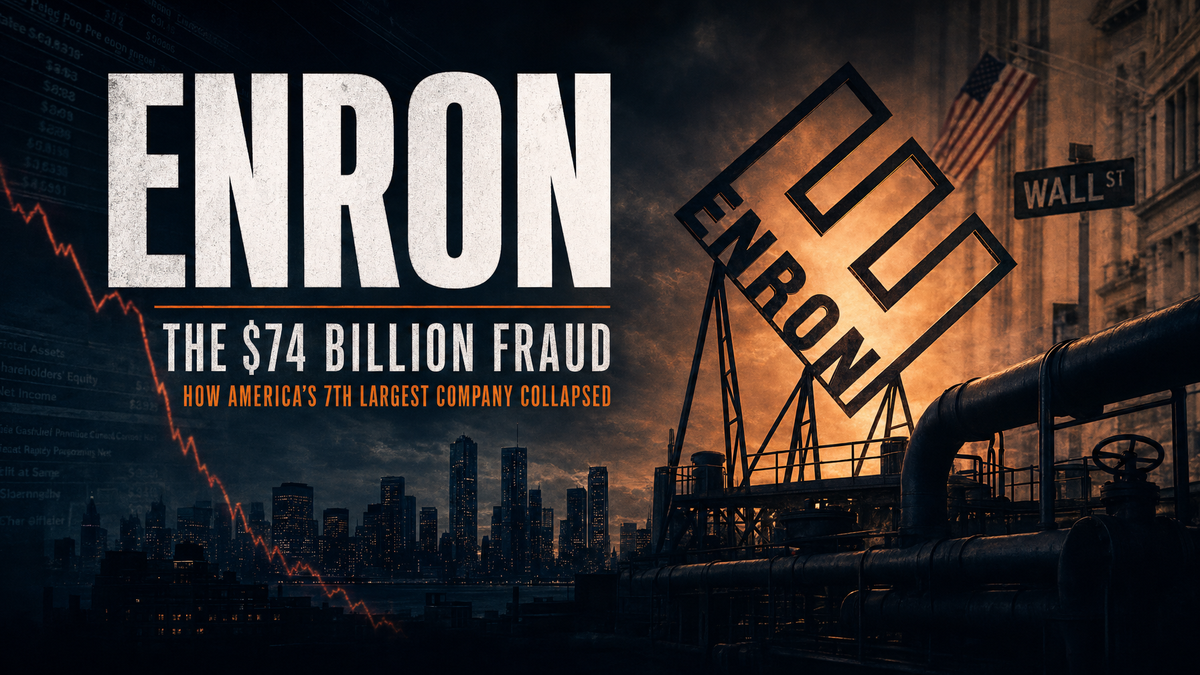
Enron's stock peaked at $90.75 in August 2000. By December 2, 2001, the company had filed for what was then the largest bankruptcy in U.S. history. Employees who had been encouraged — sometimes pressured — to hold company stock in their 401(k) plans lost an estimated $2 billion in retirement savings. Shareholders lost more than $74 billion in total market value. More than 20,000 jobs were eliminated.
The criminal prosecutions were significant. Fastow pleaded guilty to fraud and conspiracy charges and was sentenced to six years in prison. CEO Jeff Skilling was convicted on 19 counts of fraud and conspiracy and sentenced to 24 years, later reduced. Enron founder Ken Lay was convicted on 10 counts, but died of a heart attack before sentencing.
Congress passed the Sarbanes-Oxley Act in July 2002. The legislation introduced sweeping changes to corporate governance: CEOs and CFOs were required to personally certify the accuracy of financial statements under criminal penalty; auditing firms were prohibited from providing most consulting services to audit clients; a new oversight body, the Public Company Accounting Oversight Board, was created to regulate auditors. The law is widely regarded as the most significant overhaul of U.S. securities law since the New Deal era.
What Enron Actually Teaches Us About Partnerships
The surface lesson of Enron is about accounting fraud. The deeper lesson is about what happens when partnerships are structured to obscure rather than create. Every SPV Fastow created was technically a "partnership" — it had capital contributions, equity interests, legal agreements. What it did not have was any legitimate business purpose independent of Enron's need to deceive.
The investment bank partnerships that processed prepay transactions were not built on mutual value creation. They were built on mutual benefit from a shared deception. The auditing partnership that looked away was not fulfilling its role as an independent check — it had been financially captured.
When evaluating any partnership structure — whether you are a founder considering a joint venture, an investor reviewing a fund structure, or an executive assessing a strategic alliance — the question that Enron permanently added to the checklist is this: what is this partnership designed to do that the parties could not do separately, and is that purpose legitimate?
At Enron, the honest answer to that question was: hide the truth. And when the truth surfaced anyway, it destroyed everything it had touched.


