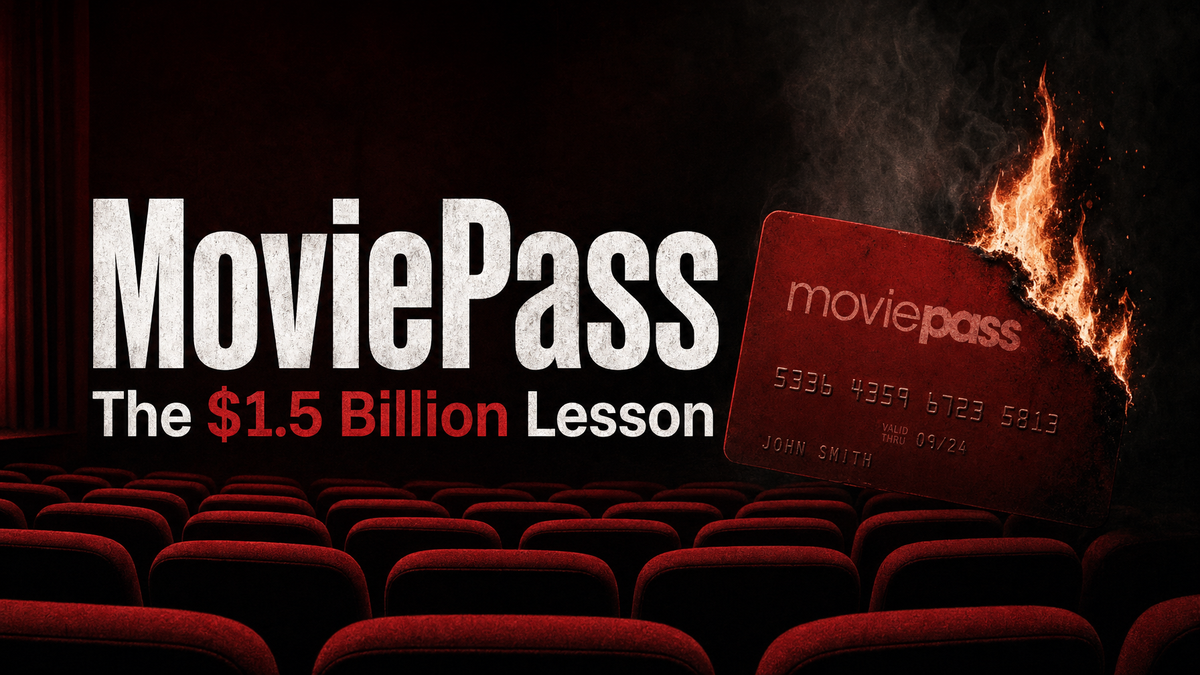
MoviePass: The Partnership That Promised to Revolutionize Cinema and Burned $1.5 Billion
MoviePass had real demand and real theater partnerships, but the business model required its own customers to use the product less than they ever would.
The Startup That Decided to Lose Money on Every Transaction and Make It Up in Volume
In August 2017, MoviePass dropped its subscription price to $9.95 per month and offered subscribers unlimited movie tickets at participating theaters nationwide. At the time, the average movie ticket in the United States cost approximately $9.11. The math was not subtle: MoviePass was paying full retail price for every ticket its subscribers redeemed, collecting less than one ticket's worth of revenue per month per subscriber, and banking on a theory of the business that required several other things to be true simultaneously — none of which were.
Within 24 hours of the price announcement, MoviePass added more than 150,000 new subscribers. Within a year, it had more than three million. The money left the company at a rate that eventually reached $21.7 million in a single month. By 2019, MoviePass had effectively ceased to function. By 2020, it had shut down entirely. The losses attributed to the venture exceeded $1.5 billion.
This is a story about partnership economics — specifically about what happens when a business builds its entire model around partnerships with entities that have no reason to cooperate with it, and when the economic structure of those partnerships is not merely thin but structurally impossible.
The Theater Partnership That Never Actually Existed
MoviePass marketed itself as a revolutionary partnership with the movie theater industry. The reality was considerably more adversarial. MoviePass purchased tickets through a standard debit card — it gave subscribers a debit card that was loaded with the ticket price at the moment of a reservation. The theaters received full retail price per ticket. MoviePass received nothing from the theaters in return: no revenue share, no data licensing fee, no promotional arrangement.
The major theater chains — AMC, Regal, Cinemark — were not partners in any meaningful sense. They were vendors that MoviePass was paying full price to. And unlike a genuine partnership, the theaters had no obligation to sustain MoviePass's model, no incentive to give it preferential treatment, and every incentive to develop competing products.
AMC's CEO Adam Aron was explicit about his hostility toward MoviePass, calling the model "not in the best interests of theater owners." AMC launched its own subscription service, AMC A-List, in 2018. Regal launched Regal Unlimited. Cinemark introduced Movie Club. Each of these programs was built with actual economics — they were designed by companies that controlled the underlying ticket supply and could calibrate pricing accordingly. MoviePass, by contrast, was a middleman that had inserted itself between consumers and theaters without securing any of the preferential terms that would be required to make that position financially viable.
The Business Model That Required Magic to Work
CEO Mitch Lowe and the leadership team at Helios and Matheson Analytics, which acquired a controlling stake in MoviePass in 2017, articulated several theories for how the company would eventually reach profitability. None of them were mathematically coherent.
The first theory was that subscribers would not use the service as often as the price implied. This is the "gym membership" model — gyms rely on members paying for access they rarely use. The flaw in applying this logic to MoviePass was that movie tickets are purchased intentionally, at a specific time, for a specific showing. A gym member forgets to go. A MoviePass subscriber goes to the movie they paid to see. Lowe himself acknowledged that heavy users were redeeming tickets far more frequently than the model assumed. Some subscribers were going to a movie every day. MoviePass's response was to implement progressively more aggressive restrictions on usage — capping redemptions, blocking popular showtimes, removing major releases from the app — which destroyed the product's value proposition.
The second theory was data monetization. MoviePass collected geolocation data and viewing preferences from its subscribers and argued that this data would eventually be worth more than the cost of acquiring it. The problem with this theory was timing: the data revenue was speculative and distant, while the cash outflow was immediate and enormous. A business cannot survive on the promise of future data licensing revenue when it is burning $21 million per month on present obligations.
The third theory was that MoviePass could evolve into a broader entertainment platform — movie production, exclusive content, brand partnerships — leveraging its subscriber base as an audience. This pivot never materialized into anything that could affect the company's cash position before the cash ran out.
Helios and Matheson: When the Parent Company Makes Things Worse
Helios and Matheson Analytics was a data analytics company that acquired a majority stake in MoviePass in December 2017, betting that the subscriber data would be transformatively valuable. What followed was a masterclass in how a failing startup can be made significantly worse by a publicly traded parent company under financial pressure.
Helios and Matheson financed MoviePass's cash burn through a series of convertible notes that diluted the company's stock at an accelerating rate. Shares that traded at over $30 in 2017 fell below $0.01 by 2018. The company executed a 1-for-250 reverse stock split in an attempt to stay listed on the NASDAQ. It failed. Helios and Matheson's market capitalization went from over $300 million to effectively zero within about 18 months.
The SEC launched an investigation into Helios and Matheson in 2018, focused on the company's disclosures about MoviePass's cash burn and subscriber figures. The company was accused of misleading investors about the pace of its losses and the health of its subscriber base.
What Structurally Impossible Partnership Economics Look Like
MoviePass is studied in business schools as a pricing error. That framing is too narrow. The deeper failure was a partnership structure that was economically impossible from inception — and that remained economically impossible regardless of how many pivots the company attempted, because the fundamental relationship between MoviePass and its theater "partners" never changed.
A viable partnership requires that both parties receive value from the arrangement. MoviePass gave theaters full ticket revenue and received nothing. It had no leverage to negotiate preferential terms, no data on future demand that theaters couldn't access themselves, and no product that theaters needed in order to operate their own business. MoviePass needed theaters far more than theaters needed MoviePass — and that asymmetry made every theory of the business that depended on theater cooperation a fantasy.
The lesson for anyone structuring a partnership-dependent business is this: before you launch, identify precisely what you are giving your partners and what you are receiving in return. If the answer is that you are paying full price and receiving nothing other than permission to transact, you do not have a partnership. You have a customer relationship with a supplier who has no particular interest in your survival. That is not a partnership model. That is a countdown timer.
The Aftermath
MoviePass attempted a relaunch in 2022 under new management, with a more conservative pricing structure. The relaunch attracted minimal attention and the company struggled to regain relevance in a market where the major theater chains had built their own subscription products and no longer had any reason to leave the middleman position open.
Mitch Lowe has continued to speak and consult in the entertainment and technology space. Helios and Matheson filed for bankruptcy in 2019. The subscribers who paid monthly fees during the service's degraded final months — when the app would crash, block films, and limit reservations without notice — received no refunds.
The $1.5 billion that flowed through MoviePass went almost entirely to movie theaters, which had an excellent 2017 and 2018 thanks in part to the free subsidy they were receiving from a startup that believed it was disrupting them.


