
Strategic Partnerships for Founders: Why Structure Beats Connection Every Time
Most founders know partnerships are the answer, but the execution gap between knowing and actually closing deals is where almost every founder gets stuck.
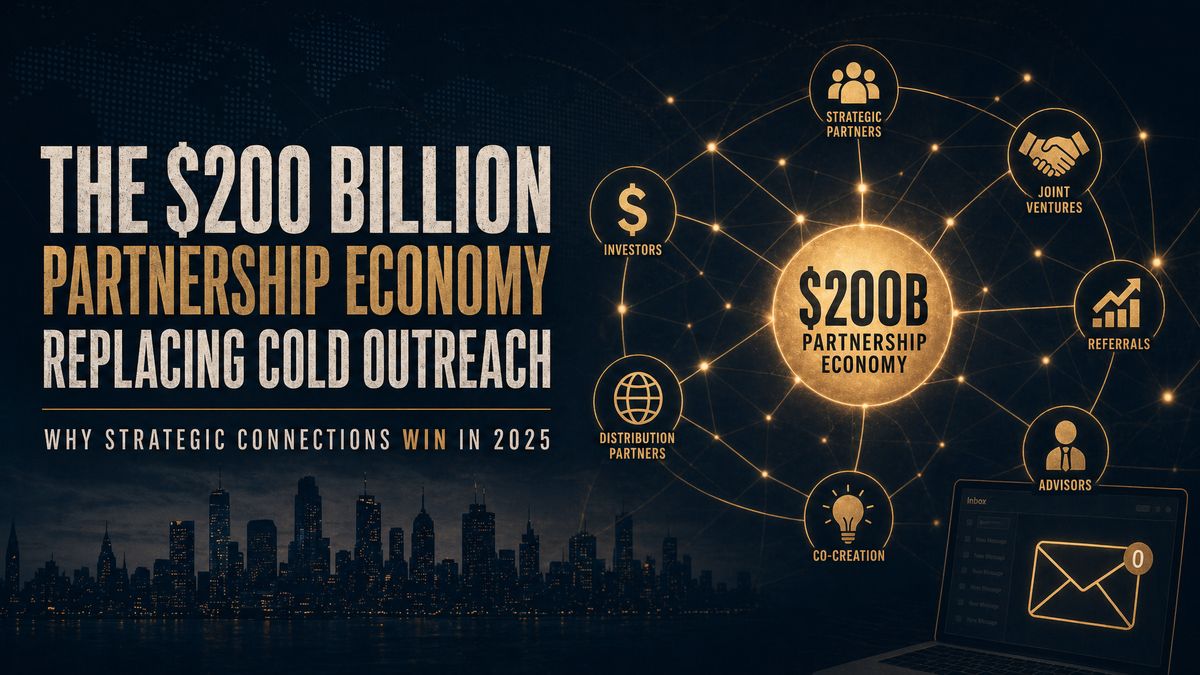
The Founders Closing the Largest Deals Are Not More Connected Than You
The founders closing the largest partnership deals in your industry are not working with a bigger network than you. They are not better connected or more charismatic or more well-known. They are more structured. And that is a problem you can actually solve.
This distinction matters because most founders are trying to solve the wrong problem. They spend time building relationships, attending events, and expanding their network, and then they wonder why so few of those relationships ever convert into real revenue. The issue is not the size of the network. The issue is the absence of a system for turning connections into structured, revenue-generating partnerships.
The Numbers Confirm What Founders Already Feel
A 2026 PwC survey found that 72 percent of executives still rely on informal networks to identify potential partners. The same year, Harvard Business Review reported that nearly 50 percent of strategic partnerships fail to meet expectations. These two statistics are not unrelated. When partner identification relies on who you happen to know, the quality of the resulting partnerships is largely a function of circumstance.
The informal networking approach produces relationships, not partnerships. A relationship is a mutual awareness and goodwill between two parties. A partnership is a structured arrangement with defined objectives, clear accountability, and measurable outcomes. Most founders have dozens of relationships that could theoretically become partnerships. Very few of them do, because neither party has a system for making that transition.
This is the gap that the most effective partnership operators have learned to close. They treat partner development as a repeatable process, not an organic outcome of relationship building. They know who they are looking for before they start looking. They know what success looks like before they make a pitch. They know how to move a promising connection through a defined pipeline and into a revenue-generating arrangement.
Why the Network-First Approach Fails
The network-first approach to strategic partnerships creates a specific type of failure that most founders experience but rarely diagnose correctly. The founder meets someone promising, has a great conversation, and agrees to explore a partnership. Both parties are excited. Then nothing happens. Weeks pass. The follow-up threads go quiet. The partnership that felt inevitable in the moment never materializes.
This happens because the excitement of a good conversation is not a pipeline. It is the beginning of a pipeline. Without a defined process for moving from a great conversation to a signed agreement generating revenue, most promising partnerships stall at the relationship stage and never advance to the execution stage.
The founders who consistently build revenue-generating partnerships have internalized this reality. They do not wait for partnerships to develop naturally. They drive them through a defined process from the first conversation forward. They know what the next step is at every stage, and they take responsibility for making it happen rather than waiting for momentum to carry things forward.
The Four-Stage Partnership Lifecycle
At onSpark, the partnership development process is organized around four stages: Discover, Verify, Launch, and Amplify. Each stage has a specific objective and a clear definition of what it means to move to the next one.
The Discover stage is about identifying partners who have real strategic fit, not just general compatibility. This means evaluating audience overlap, complementary offer structures, and aligned growth objectives before any conversation about a formal partnership takes place. Most founders skip this stage and move directly to outreach based on instinct or immediate opportunity. The result is a pipeline full of conversations that go nowhere because the fit was never real.
The Verify stage is where potential is tested against evidence. This means examining a potential partner's track record with previous partnerships, their communication patterns, and the alignment between what they say about their business and what the data supports. Trust and fit are both evaluated here using consistent criteria, not general impressions or the energy of an introductory call.
The Launch stage is where the terms of the partnership are defined and the first activities are executed together. This is not a handshake and a hope. It is a structured kickoff with defined deliverables, timelines, and accountability on both sides. The quality of the Launch stage determines whether the partnership produces early wins that build momentum or early friction that erodes trust and stalls execution.
The Amplify stage is about scaling what works. When a partnership is generating results, the most effective operators systematically identify the specific mechanisms driving those results and build on them deliberately. This might mean expanding to new audiences, adding new offer structures, or deepening the integration between the two businesses. The goal is to turn a successful partnership into a durable revenue channel rather than a one-time outcome.
What This Looks Like in Practice
Chris Seidman used the onSpark platform and partnership strategy to generate $160,000 in partnership revenue in a single month. That result did not come from a larger network or more aggressive outreach. It came from applying a structured approach to partner identification, verification, and execution within a curated network of qualified professionals.
Seidman's result is notable not because it is exceptional, but because it is repeatable. The mechanism that produced $160,000 in one month is the same mechanism available to any founder who applies the four-stage lifecycle with consistency and discipline. The process is not complicated. It requires a willingness to resist the shortcuts that most founders take because those shortcuts feel faster in the short term while producing worse outcomes over time.
The results that look exceptional from the outside are almost always the product of a process that looks ordinary from the inside. What distinguishes the founders who build $160,000 partnership months from those who are stuck at zero is not talent or connection. It is structure applied consistently over time within a network where the other participants are operating by the same standards.
The Structural Advantage Is Accessible
The PwC and HBR data describe a market where the majority of participants are still operating without a systematic approach to partnership development. This is an advantage for any founder who is willing to build one. The market is not optimized. The competition is not sophisticated. The bar for doing this better than most of your competitors is lower than it appears.
The founders who recognize this opportunity and act on it now will accumulate a structural advantage that compounds over time. Every successful partnership generates data, relationships, and credibility that make the next partnership easier to build. The founders who start building this infrastructure today will be in a fundamentally different position 12 months from now than the ones who continue relying on informal networks and intuition.
This is not a speculative claim. It is the observable pattern across the founders who are currently generating the strongest partnership revenue in the onSpark network. They started earlier, applied the process more consistently, and built a compounding track record that now makes every subsequent partnership easier to close.
Build Your Partnership Infrastructure Now
onSpark connects founders, creators, consultants, event producers, agencies, and brands with strategic partners who have been evaluated for real fit. With over 17,000 professionals in the network and more than $2 billion in partnership revenue attributed to the strategy, the platform is built for founders who are serious about partnerships as a primary revenue channel.
The waitlist for onSpark is open. Join at onspark.com and get access to the four-stage partnership lifecycle, the Trust and Fit Score framework, and a curated network of professionals who are building the same kind of structured partnerships you are looking to create.
Structure is not a constraint on your partnership strategy. It is the mechanism by which the founders closing the largest deals are building ahead of you. The waitlist is open. Start building yours now.


