
The Fake Business Coach Epidemic: How Fake Partnership Gurus Are Stealing Millions From Entrepreneurs
The business coaching industry has no licensing requirement, which makes it easy to sell content products at results pricing and disappear before the refund window opens.
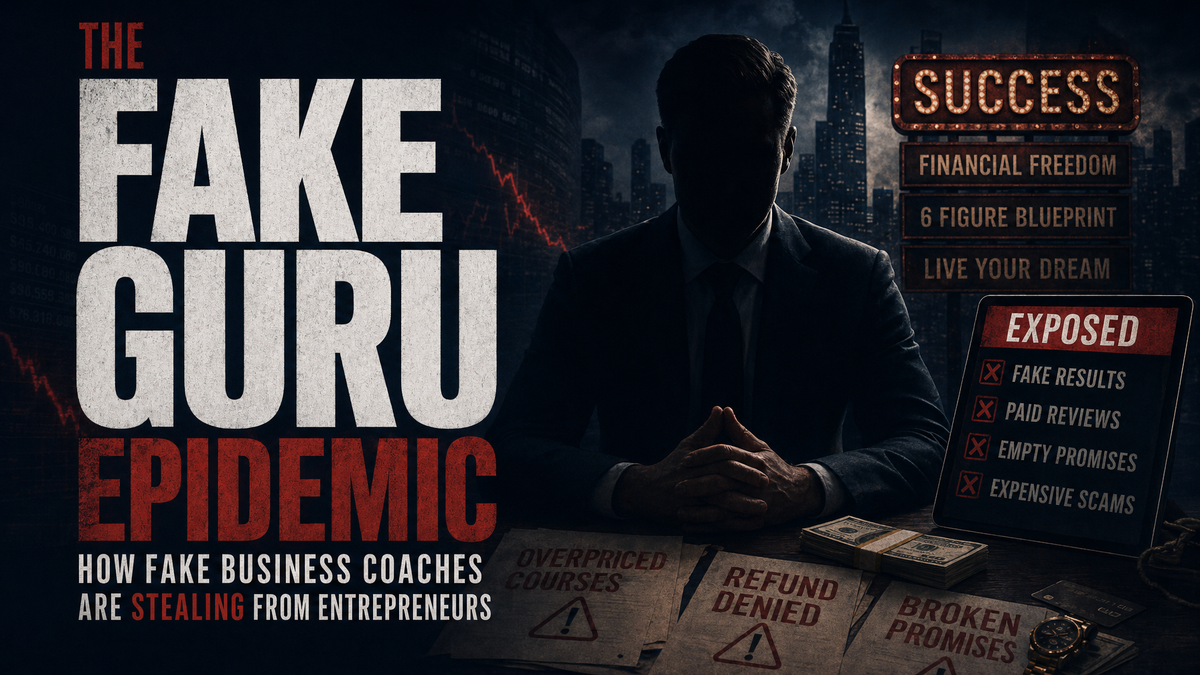
The Industry That Sells Partnerships Without Having Any
Somewhere between the legitimate world of executive coaching and the straightforward fraud of a Ponzi scheme, there exists a gray economy that has extracted billions of dollars from entrepreneurs over the past decade. It operates through Instagram reels, podcast interviews, LinkedIn thought leadership, and stage appearances at conferences where the speaker lineup is self-selected and the audience is the product.
The pitch varies in its details but is consistent in its structure: pay $10,000 to $50,000 to join a mastermind, community, or "partner network," and in exchange you will receive access to a curated group of high-caliber collaborators, a proprietary deal flow, revenue-generating introductions, and the guidance of a proven expert who has "done the thing." The reality, for a significant number of these programs, is that the network is thin or fictional, the introductions are to other paying members, the proprietary deal flow is a shared Slack channel, and the proven expert's claimed results are either unverifiable, exaggerated, or achieved under circumstances that have no relevance to your business.
This is the fake partnership guru ecosystem. It is large, it is growing, and it has become sophisticated enough that experienced founders are regularly caught in it.
How the Model Works
The business model is more coherent than it first appears. Most fake partnership gurus are not simply lying about everything — that would be easier to detect. Instead, they construct a layered reality in which some elements are true enough to provide cover for the false ones.
The guru may have genuinely built a business of some kind. They may have a real social media following. They may have had one or two authentic partnerships that generated revenue. These real elements are then used to anchor an income claim that is either unverifiable or misleading. "$10 million in partnership revenue" may technically be true in the sense that the guru moved through transactions totaling that amount — without mentioning that their margin was negligible, the revenue came from a single deal five years ago, or the number includes gross revenue of client businesses they advised peripherally.
On top of that foundation, the program is built. The mastermind cohort is real. The community platform is real. The weekly calls are real. What is not real is the specific outcome the marketing promised: a functioning partner network, a pipeline of qualified introductions, a proprietary system that predictably generates revenue. Those deliverables are vague enough to be unprovable, which means they are also immune to the customer service department.
The Red Flags: What to Watch Before You Pay
The fake partnership guru ecosystem has a recognizable signature. Once you know what to look for, it becomes difficult to unsee.
Income claims without verification. Any program that leads with specific revenue numbers — "I made $4.7 million in partnerships last year" — and cannot or will not provide independent verification of those numbers should be treated with extreme skepticism. Screenshots of Stripe dashboards are trivially easy to fabricate. Tax returns are not. Ask for verifiable documentation. The refusal to provide it is the answer.
Access-based pricing. When the primary value proposition is "access to my network" rather than a specific skill or knowledge transfer, you are paying for a relationship that may or may not materialize. Legitimate partnership professionals can articulate what they will teach you. Illegitimate ones sell proximity to themselves as the product.
Vague deliverables. Read the sales page carefully. What, specifically, will you receive? If the answer involves words like "community," "ecosystem," "curated connections," "deal flow," or "introductions," ask for a precise definition. How many introductions? To whom? With what qualification criteria? What happens if the introductions produce no revenue? Programs with real deliverables can answer these questions. Programs built on vague promises cannot, and they will tell you that you're "thinking too transactionally."
Fake social proof. Testimonials in this space are often either fabricated, selectively curated from the program's best-case outliers, or provided by people who received the testimonial as part of a reciprocal arrangement. Look for testimonials that include verifiable specifics: company name, revenue figure, timeline. Search for the people giving testimonials independently. A testimonial from someone whose LinkedIn profile was created six months ago is not evidence of anything.
Urgency and scarcity manufacturing. "Only 3 spots left" and "price goes up Friday" are standard pressure tactics designed to compress your decision-making window below the threshold required for adequate due diligence. Real programs with real value do not need to manufacture urgency.
The high-ticket upsell ladder. Many fake partnership programs operate on a funnel model: a $97 course leads to a $3,000 workshop, which leads to a $15,000 mastermind, which leads to a $50,000 "inner circle." Each level promises that the real value is one more step up. This structure is designed to extract maximum revenue before the customer recognizes the pattern.
The Ecosystem That Enables It
The fake business coach economy does not exist in isolation. It is sustained by a broader ecosystem of co-dependent relationships: podcast hosts who invite coaches onto their shows in exchange for promotion; conference organizers who sell speaking slots to anyone willing to pay; affiliate marketers who earn commissions recommending programs they have never evaluated; and platforms like Instagram and YouTube that amplify lifestyle-aspirational content regardless of the accuracy of its underlying claims.
This ecosystem is itself a kind of fake partnership network — a web of mutually beneficial promotional relationships that creates the appearance of a credible professional community around figures who have no business teaching what they teach. When a business coach appears on 40 podcasts and speaks at 12 events in a year, the social proof generated is not evidence of expertise. It is evidence of a promotional budget.
How to Vet Any Business Development Program Before Paying
Due diligence in this space follows a simple framework.
First, verify the results claim. Ask for documentation that can be independently confirmed. A refusal to provide this documentation does not require further analysis.
Second, talk to past clients without going through the guru's referral list. Any program that will only connect you with pre-selected alumni is controlling the information you receive. Find past participants independently — search LinkedIn for the program name, look for public reviews, reach out cold to people who have mentioned the program publicly.
Third, get the deliverables in writing before paying. If the program cannot articulate what it will specifically deliver, by when, and with what remedy if those deliverables are not met, the contract you are signing is for nothing in particular.
Fourth, understand the refund policy before you are emotionally invested. Programs with real confidence in their product offer real refund windows. Programs that charge $25,000 and offer no refund after day one are pricing in the probability that you will be dissatisfied.
Finally, and perhaps most importantly: slow down. The pressure to decide quickly is almost always a red flag. Any legitimate program will still exist next week. The urgency you feel is manufactured, and it is manufactured specifically to prevent you from doing the research that would reveal what the program actually is.
The partnership economy is real. There are legitimate coaches, genuine mastermind groups, and authentic professional networks that create significant value for their members. The existence of a predatory industry around them does not negate that. But in a space where the product is trust and access, the cost of inadequate due diligence is not just financial. It is the opportunity cost of a year or more spent inside a program that was never going to work — time that cannot be recovered.


