
The Real Reason Your Partnership Pipeline Is Empty (And It Has Nothing to Do With Your Network)
Most founders have the contacts they need, but without a conversion process, every relationship stays exactly what it was at the first handshake.
The Wrong Diagnosis Is Costing You
When a founder's partnership pipeline is thin, the instinctive diagnosis is almost always the same: "I need a better network." So they attend more events, optimize their LinkedIn profile, join more communities, and get better at small talk at industry dinners. Then, six months later, the pipeline is still thin, the network is larger, and the confusion is deeper.
The diagnosis was wrong. A thin partnership pipeline is rarely a network problem. It is almost always an operations problem — a failure of process, not of access. Most founders already have relationships with people who could generate significant revenue as partners. The gap is the systematic work required to identify, qualify, pitch, and close those relationships commercially.
This distinction matters because the solutions are completely different. A network problem is solved by meeting more people. An operations problem is solved by building a process. Only one of those solutions actually fills a pipeline.
What an Operations Problem Actually Looks Like
Operations problems in partnership development tend to cluster around three failure modes.
The first is no defined target partner profile. Most founders pursue partners reactively — responding to inbound interest, chasing whoever seems most enthusiastic, or defaulting to whoever they met most recently at a conference. Without a clearly defined ideal partner profile (what audience size, what engagement rate, what category alignment, what growth stage), every opportunity looks equally interesting or equally uncertain. The result is a pipeline full of maybes and a process that never produces a close.
The second is no structured outreach system. Partnership outreach in most early-stage companies happens in someone's personal inbox, tracked in a spreadsheet (if tracked at all), with no standardized pitch, no follow-up cadence, and no way to measure pipeline velocity. When the founder who owns the relationships leaves or shifts focus, the entire pipeline evaporates. This is not a coincidence. It is what happens when a high-leverage business function operates like a hobby.
The third is no clear value proposition for partners. Most founders pitch partnerships from the perspective of what they need — distribution, introductions, co-marketing reach. Effective partnership pitches lead with what the partner receives. What is the commercial upside for them? What is the audience overlap that makes this efficient? What has been the outcome for similar partners in similar positions? Founders who cannot answer these questions confidently will hear "sounds interesting, let's stay in touch" on every call and never advance to a signed agreement.
The 4-Stage Partnership Process: Discover, Verify, Launch, Amplify
The operational fix for an empty pipeline is not complicated. It is a four-stage process that most partnership teams at scaled companies already use and that founders consistently underinvest in.
Stage 1: Discover
Discovery is the structured identification of potential partners against a defined target profile. This is not browsing LinkedIn. It is a systematic search across your existing network, complementary platforms, and category-specific databases to surface candidates who meet specific commercial criteria: relevant audience, sufficient reach, non-competing offer, and demonstrated history of referral or co-marketing activity.
The output of the Discovery stage is a list of qualified candidates, not a list of interesting people. If you cannot distinguish between those two categories, your Discovery process is not working.
Stage 2: Verify
Verification is the due diligence step that most founders skip entirely. Before investing relationship capital in a partnership pitch, you need to confirm three things: that the partner's audience is genuinely engaged (not just large), that the partner has capacity to actually execute (not just enthusiasm for the idea), and that the commercial fit is real (that your offer is genuinely relevant to their audience's current needs).
Verification kills roughly 40% of candidates who looked good at Discovery. This is not a failure — it is the system working. Every hour you do not spend on a partner who was never going to convert is an hour available for one who will.
Stage 3: Launch
Launch is the execution of the first partnership activation: the newsletter feature, the co-hosted event, the referral program rollout, the integration announcement. The Launch stage should have a defined scope, a concrete timeline, and a named owner on both sides. If a partnership cannot be launched with a specific deliverable within 60 days of the agreement being signed, the structure is too complex for the current stage of the relationship.
Start with small, fast activations that generate real data. A single newsletter feature that drives 40 qualified sign-ups is more valuable than a six-month joint campaign that has not launched yet.
Stage 4: Amplify
Amplification is the most underutilized stage in partnership operations. Once a partner has generated a measurable outcome — referrals, revenue, engagement — the next step is to systematically increase the surface area of the relationship. This means additional activation formats, deeper integration, affiliate agreements, co-created products, or expansion into new audience segments.
The founders who generate the most consistent partnership revenue do not have the most partnerships. They have the deepest ones — relationships that have been amplified through multiple activation cycles until the commercial output is predictable and compounding.
The Cost of Skipping the Process
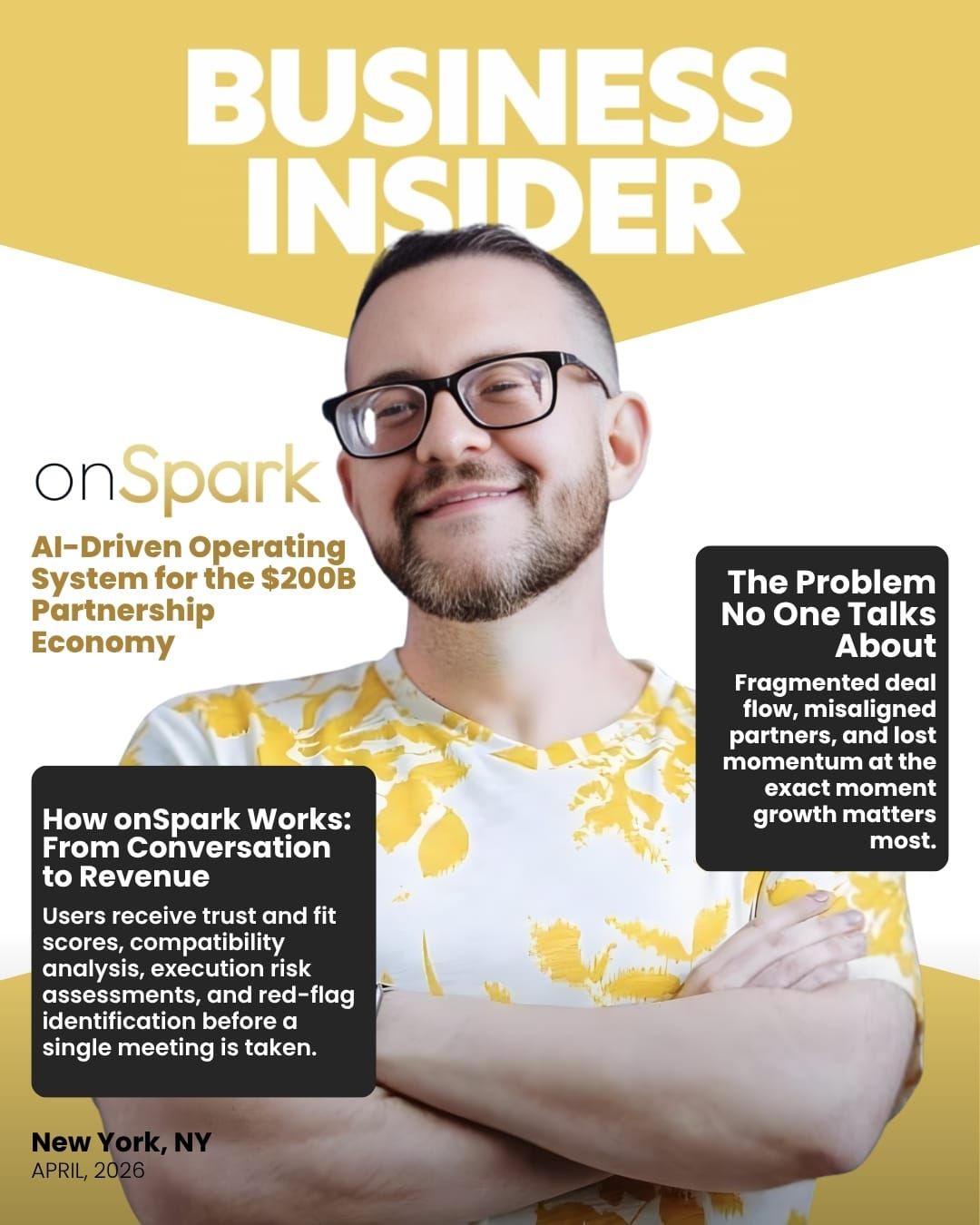
The economics of a functional partnership operation are significant. onSpark AI's platform is built around exactly this four-stage framework — with AI matching at the Discovery and Verification stages, structured activation tools at Launch, and performance tracking at Amplification. The platform costs $750/month versus $75,000+ for an in-house BD hire to build and run the same process manually. That is an 88% cost reduction for a more rigorous operation.
More importantly: the founders who have run this process through onSpark's platform do not have thin pipelines. Chris Seidman generated $160,000 in a single month. HubSpot's GTM Partnerships team reported a 10x increase in qualified global leads. These outcomes are not attributable to superior networks. They are attributable to a superior process applied to the networks they already had.
Start With an Honest Audit
Before investing another month in networking events, take 90 minutes and audit your current partnership situation against the four stages. Do you have a defined target partner profile? Do you have a list of verified candidates who meet that profile? Do you have an active launch in progress with a specific deliverable and timeline? Do you have at least one past partnership you have amplified beyond the initial activation?
If the answer to any of those questions is no, you have found your operations gap. The network is not the problem. It never was.
onSpark AI is the AI-powered partnership platform built to run the Discover, Verify, Launch, Amplify process at scale. Learn more at onspark.com.


