
What HubSpot's 10x Lead Growth From onSpark Actually Means for Founder Distribution Strategy
HubSpot outgrew its competitors through a partner ecosystem rather than ad spend, and the distribution model it built applies to founders at any stage.
When Enterprise BD Teams Move, Pay Attention
Enterprise business development teams are conservative by nature. They move slowly, they run multi-vendor comparisons, and they are accountable to metrics that make experimentation uncomfortable. When an enterprise BD team reports a 10x increase in qualified leads from a single platform — and specifically notes that the platform outperformed every other tool in the same window — that is not a casual endorsement. That is a signal about where the market is heading.
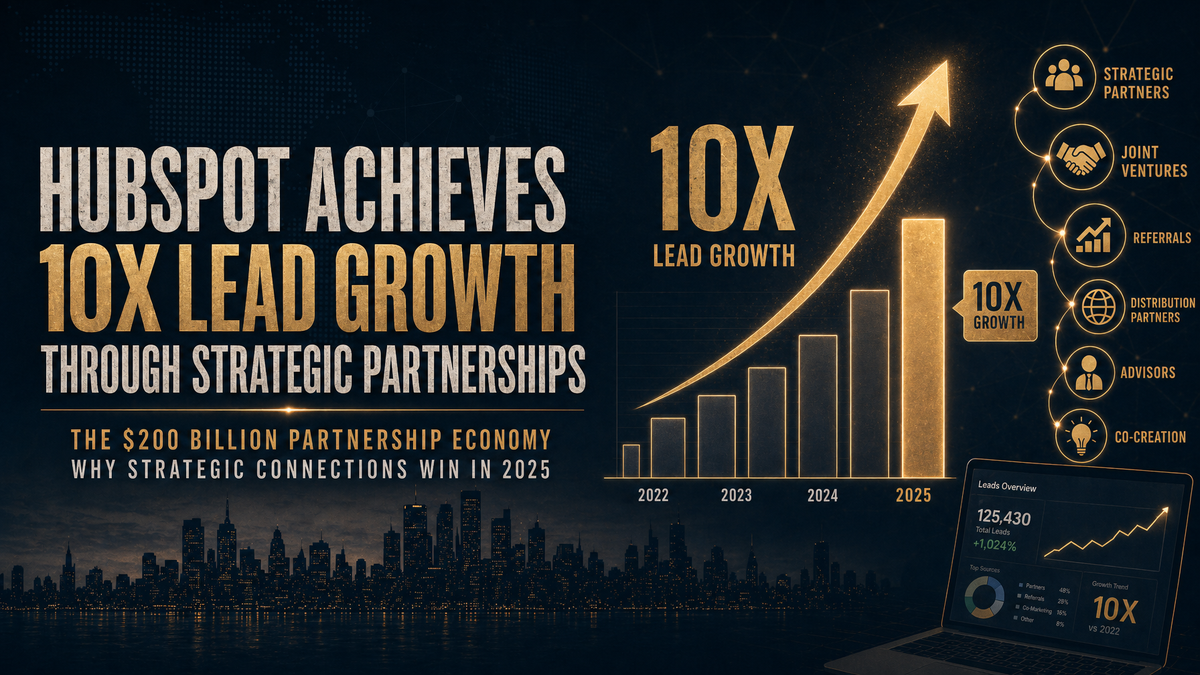
HubSpot's GTM Partnerships team did exactly that with onSpark AI. Caragh Kennedy, who leads that function, reported a 10x increase in qualified global leads after adopting the platform — results that outperformed all other tools the team was running simultaneously. For a company of HubSpot's size, sophistication, and vendor scrutiny, that outcome requires explanation. Not to celebrate onSpark, but to understand what it reveals about the structural shift in how distribution strategy actually works in 2026.
What Enterprise BD Teams Are Actually Optimizing For in 2026
For the past decade, enterprise BD strategy was primarily optimized for volume. The goal was pipeline coverage — enough meetings, enough conversations, enough activity to generate statistical certainty of deals. Tools were evaluated on reach: how many contacts can you access, how fast can you sequence outreach, how broadly can you blanket a market.
That model has degraded significantly. Enterprise buyers are more resistant to cold outreach than at any point in the past 20 years. Response rates to cold email have declined by more than 50% since 2021 according to multiple sales intelligence benchmarks. The volume model produces diminishing returns because the underlying behavior it relies on — strangers opening unsolicited outreach — is becoming rarer.
The enterprise BD teams that are performing in 2026 have shifted their optimization target from volume to verification. Instead of asking "how many people can we reach?", they are asking "how many verified, commercially aligned partners can we identify and activate?" The shift is from spray-and-pray distribution to precision distribution — and that is precisely where onSpark's architecture has an asymmetric advantage.
Why 10x Qualified Leads Is the Specific Metric That Matters
It would be easy to dismiss a 10x lead increase as top-of-funnel noise if the leads were not qualified. But Caragh Kennedy's characterization was specific: qualified global leads. This is the metric that enterprise BD teams are actually accountable to — not total meetings booked, not impressions on a co-marketing campaign, not newsletter opens. Qualified leads that move through a pipeline and generate revenue.
The distinction between total leads and qualified leads in a partnership context reflects the core problem that most partnership platforms fail to solve. Generating introductions is trivial. Generating introductions to people who have the right audience, the right commercial alignment, and the right incentive to partner — at scale, globally, without requiring a senior BD hire to manually research and vet each candidate — is the hard problem. That is where the 10x number lives.
For HubSpot's GTM team, operating at global scale across dozens of market segments, the ability to surface verified, commercially aligned partner candidates rather than raw contact lists is the difference between a tool that creates work and a tool that generates outcomes. The 10x result is the product of the verification layer, not the volume layer.
What This Means for Founders Competing for the Same Distribution
Here is the uncomfortable implication that most founders miss: when enterprise BD teams adopt a platform that generates 10x qualified leads, they are not just getting better results. They are occupying distribution relationships before you reach them.
The most valuable partners in any ecosystem — the newsletters with 50,000 engaged subscribers, the podcasts with proven conversion histories, the creator networks with commercial-grade audiences — are finite resources. Enterprise BD teams with platforms that surface and activate these partners quickly will lock up the best relationships before founders running manual outreach processes even identify them as targets.
This is not a theoretical concern. It is already happening. The partnership economy is moving toward a model where speed of identification and quality of match determine access to distribution — and founders who rely on manual networking to discover partnership opportunities are competing against enterprise teams running AI-assisted matching pipelines. The outcome of that competition is predictable.
The Leveling Mechanism
The reason onSpark AI's $750/month subscription model matters at this specific moment is not just the cost savings (although 88% savings versus in-house BD is significant). It is that the platform gives founder-stage companies access to the same verification and matching infrastructure that is generating 10x results for enterprise BD teams.
A founder with a $9,000 annual onSpark subscription is running a partnership discovery and verification process at roughly the same level of sophistication as HubSpot's GTM team. The network of 17,000+ verified professionals in-network, the AI matching across nine partnership categories, the attribution of $2B+ in partnership revenue — these are not enterprise features gated behind enterprise pricing. They are available to any founder who decides that partnership distribution is worth treating as a serious business function.
Dan Martell, whose backing of onSpark through Martell Ventures is itself a signal of conviction, made this point directly: the platform addresses the fundamental leverage problem in founder-stage growth, where the cost of building a professional BD function has historically been prohibitive at the stage when it would be most valuable.
The Inference for Distribution Strategy
The HubSpot case is not primarily a story about onSpark. It is a story about where enterprise BD capital is flowing and why. The most sophisticated buyers of growth infrastructure in the world are moving toward verified, AI-matched partnership distribution and away from volume-based outreach. That directional signal is worth more than any single case study metric.
For founders building distribution strategy in 2026, the practical implication is straightforward: the partnership channel is becoming more competitive and more valuable simultaneously. The window to establish strong partner relationships before enterprise teams with superior tooling occupy the best positions is narrowing. The founders who move now, with a structured process and a platform built for verified matching, will have a distribution advantage that compounds over time. The ones who wait will be renegotiating for table scraps in markets that enterprise BD teams have already consolidated.
The 10x number is not a product claim. It is a directional signal. Read it accordingly.
onSpark AI is the AI-powered partnership platform that generated HubSpot's GTM Partnerships team a 10x increase in qualified global leads. The platform is open to founders, creators, consultants, and brands at onspark.com.


