
Why Founders Who Are Great at Networking Still Fail at Partnerships (They're Not the Same Thing)
Most founders spend years collecting contacts and building goodwill while their partnership pipeline stays empty and their competitors quietly scale around them.
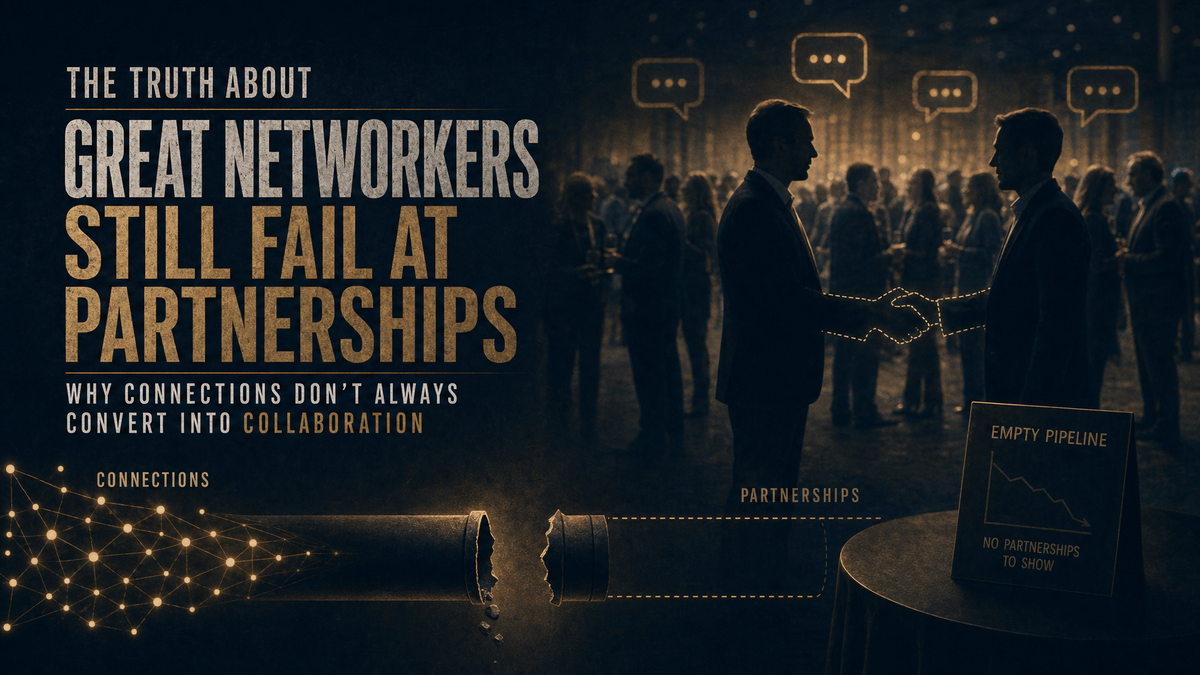
The Most Dangerous Lie in Founder Culture
The most expensive belief a founder can hold is that being good at networking means they are building a partnership pipeline. These two activities share almost nothing in common except the people involved. One is a social behavior. The other is a business process. Conflating them is why founders with extraordinary networks and genuine personal charisma routinely end up with empty partnership pipelines and no clear explanation for why.
The founder who has spoken at 12 conferences, attended every major industry summit, and has 8,000 LinkedIn connections is not necessarily a better partnership candidate than the founder who has been head-down for three years and has 400. What matters is not the size or warmth of your network. It is whether you have a repeatable system to convert relationship capital into commercial agreements.
Most founders do not have that system. They have relationships. And relationships, without structure, do not automatically become partnerships.
What Networking Actually Produces
Networking produces three things reliably: mutual goodwill, reciprocal visibility, and access. All three are genuinely valuable. None of them are partnerships.
Mutual goodwill means someone thinks well of you and wants to be helpful if the right opportunity arises. That is a nice foundation for a future relationship. It is not a commercial agreement.
Reciprocal visibility means you appear in each other's feeds, show up at each other's events, and tag each other occasionally. This creates the impression of a relationship without necessarily creating the substance of one. More importantly, it creates no accountability, no deliverable, and no revenue.
Access means you can get a response to an email. This is more valuable than most founders acknowledge — access is a genuine asset. But access only converts into partnership revenue when you have a specific ask, a clear value exchange, and a structured proposal to put in front of the person you have access to. Most founders have the access and never convert it because they lack the other two elements.
Why Networking Theater Is So Common
Networking feels productive because it involves constant motion, visible social activity, and immediate positive feedback. People are pleased to see you. Conversations go well. You leave with cards, LinkedIn connections, and genuine warmth. The feedback loop is immediate and rewarding.
Partnership development feels harder because it requires specificity. You have to identify a defined target partner, articulate a clear value exchange, propose a concrete structure, negotiate terms, align timelines, and manage execution. There is no warm applause at the end of a partnership pitch. There is a yes or a no, then months of work before you see revenue.
The discomfort of that specificity is why most founders default back to networking. It is not laziness. It is a rational response to a reward structure that favors social activity over operational rigor. Conferences give you dopamine hits. Partnership pipelines give you revenue. These are not the same experience.
What Makes a Partnership Real
A real partnership has four components that networking never requires: a defined value exchange, a specific deliverable, a timeline, and accountability.
A defined value exchange means both parties can articulate precisely what they are giving and receiving. "We will support each other" is not a value exchange. "We will feature your offer to our 22,000 subscribers in our next two newsletters in exchange for a dedicated feature of our platform to your community of 8,000 founders" is a value exchange.
A specific deliverable means the output of the partnership is concrete and measurable. Impressions, referrals, revenue, introductions — whatever the currency, it must be countable. If you cannot measure whether the partnership is working at 60 days, it is not a real partnership. It is an experiment with no hypothesis.
A timeline creates urgency and a shared expectation of progress. Partnerships that lack timelines tend to drift. Both parties remain "aligned" while nothing actually happens because neither side has enough pressure to prioritize execution over everything else competing for their attention.
Accountability means someone on each side owns the relationship commercially, not just socially. This is the piece that breaks down most often in founder partnerships. The person who was enthusiastic in the initial meeting is often not the person who executes the activation. Without a named owner and a check-in cadence, even well-structured agreements decay into the same vague mutual goodwill that networking produces.
The Structural Test
Here is a simple test for any relationship in your network. Ask yourself: if I needed this person to generate 10 qualified referrals for my business within 90 days, do I have a specific ask, a clear value exchange, and a mechanism to track outcomes? If the answer is no, you have a network contact, not a partnership candidate — yet.
The gap between "yet" and "never" is entirely a function of whether you build the process to bridge it. That process does not require a large team or a significant budget. It requires a structured approach to identifying which contacts have the audience, incentive, and capacity to partner commercially, and a clear system for converting that potential into an agreement.
This is the infrastructure gap that onSpark AI addresses directly. The platform's 17,000+ member network is organized not by who knows whom, but by who can deliver what to whom — across nine distinct partnership categories. Chris Seidman generated $160,000 in a single month using the platform. He did not do that because he had a great network. He did it because he had a platform that converted network access into structured, commercial-grade partnerships at scale.
The Reframe That Changes Everything
Stop asking "who should I be building relationships with?" That question produces a networking calendar. Start asking "which of my existing relationships can I structure into a partnership this quarter, and what is the specific value exchange that makes it worth their time?" That question produces a pipeline.
The founders who consistently generate partnership revenue are not more socially gifted than their peers. They are more operationally disciplined. They treat partnerships as a business function with inputs, outputs, and accountability — not as a byproduct of being well-liked.
Networking is not a partnership strategy. It is a prerequisite for one. The strategy comes from what you do with the access after the event ends.
onSpark AI is the AI-powered partnership platform built to convert relationship capital into verified, revenue-generating partnerships. Learn more at onspark.com.


