Why Partnerships Fail: The Real Reason No One Talks About
Partnership failure follows predictable structural patterns that most founders only recognize after spending six months on a deal that was never going to close.
The Advice You Got Was Wrong
Most founders believe partnerships fail because of bad contracts, misaligned incentives, or an equity split that looked fair on paper. This is the conventional diagnosis, and it is wrong. The real reason partnerships fail is that founders pick the wrong partner for the wrong psychological reason and then call the decision strategy.
This is not a comfortable conclusion. It is, however, an accurate one. If you have ever watched a partnership collapse despite tight legal agreements and shared financial upside, you already know this instinctively. The contract was not the problem. The selection process was.
The Problem Is Not the Contract
When a partnership falls apart, the post-mortem almost always focuses on the mechanics. Someone did not perform. The goals were never aligned. The agreement was not specific enough. These observations are true on a surface level, but they describe symptoms rather than causes. Fixing the contract after a bad partner selection is equivalent to adjusting the sails after choosing the wrong destination.
The selection process itself is where the failure begins. Founders routinely describe their best partnerships as those where they felt an immediate connection with the other person. They talk about energy, shared vision, and mutual respect. These qualities matter, but they are not sufficient criteria for a strategic partnership. They describe emotional chemistry, which is a real thing, but not a strategic framework.
When emotional chemistry gets mistaken for strategic compatibility, founders move fast and skip the verification steps that would surface real incompatibilities. They skip revenue modeling, shared audience analysis, and clear accountability mapping. They assume the relationship will work because it feels right. Months later, when deliverables are missed and expectations go unmet, both parties are genuinely surprised.
What Psychology Says About This Pattern
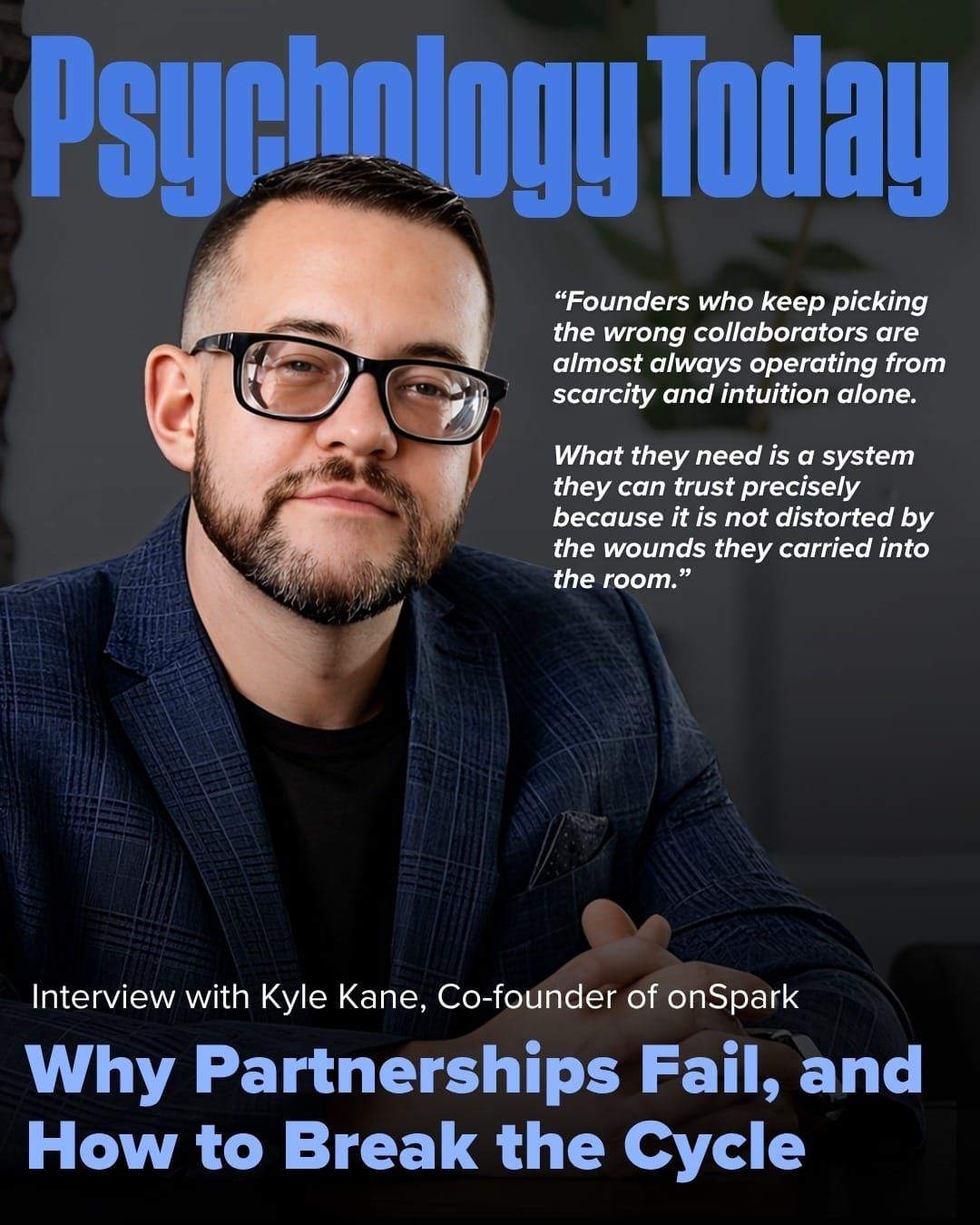
In April 2026, Psychology Today published a feature examining the psychological factors behind partnership failure. The piece identified a pattern that experienced partnership professionals recognize immediately: founders bring their attachment styles into business relationships the same way people bring them into personal ones.
Founders who rely on gut feel during partner selection are often responding to emotional cues that have nothing to do with strategic fit. Someone who communicates similarly, who shares a background, or who projects confidence can feel like the right partner long before any real due diligence has taken place. The brain patterns that make a potential partner feel trustworthy are the same patterns that can obscure a fundamental misalignment in goals, capacity, or commitment.
Kyle Kane, co-founder of onSpark and a featured source in the Psychology Today piece, has observed this pattern across hundreds of partnership conversations. The founders who build durable, revenue-generating partnerships are not the ones who felt the strongest connection at first. They are the ones who followed a structured qualification process before the relationship moved forward.
This distinction between emotional chemistry and structural compatibility is at the core of why most partnerships underperform, and why a small minority of founders consistently build partnerships that compound over time.
The Role of Structural Compatibility
Structural compatibility means two potential partners have alignment across the dimensions that actually predict partnership success. These include audience overlap, revenue model fit, complementary capabilities, and compatible working styles. None of these can be assessed from a 30-minute call or a shared excitement about each other's work.
The founders who get this right do not rely on instinct alone. They use a consistent process for evaluating potential partners before committing time, brand credibility, or shared audience access to the relationship. They ask the questions that feel awkward to ask early, because they have learned that the awkwardness of an early conversation is far less costly than the friction of a failed partnership six months in.
This is a learnable skill. It requires a framework, not just good judgment. And the founders who build it consistently outperform those who do not.
The Trust and Fit Score Framework
At onSpark, the Trust and Fit Score is the structural answer to partnership mismatch. It is a qualification framework that gives founders a consistent, objective way to evaluate potential partners before any formal agreement is made.
The framework evaluates two distinct categories. Trust covers the indicators that a potential partner will follow through on commitments: communication consistency, track record with previous partners, and alignment between stated values and observable behavior. Fit covers the strategic dimensions that determine whether the partnership has a real chance of generating returns: audience overlap, complementary offer structures, shared growth stage, and compatible definitions of success.
Most founders evaluate one of these categories informally and ignore the other entirely. They either focus on whether they like and trust the person, or they focus on whether the business case makes sense on paper. The Trust and Fit Score requires both, evaluated in parallel, using specific criteria rather than general impressions.
When founders apply this framework, the selection process slows down in the early stages and accelerates significantly later. Fewer partnerships get started, but the ones that do move forward are built on a foundation that holds under pressure. The failure rate drops not because the partners are luckier, but because the qualification standard is higher.
Why Getting This Right Changes Everything
A partnership with the right structural fit does not require constant management to stay on track. The incentives align naturally because the partners are working toward compatible outcomes. The communication is easier because both parties define success the same way. The trust is durable because it was built on verified evidence rather than emotional resonance.
This is not an idealized version of what partnerships could look like. It is a description of what partnerships look like when they are built correctly from the beginning. The founders who experience this consistently are not luckier than the ones who do not. They are more disciplined about the selection process.
The broader market is beginning to recognize this. The Psychology Today feature on partnership failure generated significant engagement precisely because the patterns it described are widely recognized but rarely named. Founders know when a partnership feels off. What they often lack is a framework for identifying why before they have already committed.
What to Do Differently
Start with the qualification criteria before you start with the conversation. Know what you need from a strategic partnership in terms of audience access, revenue potential, and complementary capability before you begin evaluating specific candidates. This prevents the emotional chemistry bias from driving decisions that should be driven by data.
Apply a consistent evaluation framework to every potential partner, regardless of how promising the initial conversation feels. The founders who use a tool like the Trust and Fit Score do not skip the framework for the partners they are most excited about. Those are precisely the partnerships that require the most rigorous evaluation.
Move slowly through qualification and quickly through execution. Most founders do this backward. They rush into agreements before verifiable compatibility has been established, then move slowly through execution because the misalignment shows up in every decision.
Track your results. Know which partnerships are generating revenue, which are generating activity without revenue, and which have stalled. This data is essential for refining your partner selection process over time and for identifying the patterns in your own decision-making that are costing you results.
The Structural Answer Is Available Now
onSpark was built because the partnership failure rate is not inevitable. It is the result of a broken selection process, and broken processes can be fixed. The platform connects founders, creators, consultants, and brands with strategic partners who have been evaluated for trust and fit, not just filtered by industry or follower count.
With over 17,000 professionals in the onSpark network and more than $2 billion in partnership revenue attributed to the strategy, the evidence is clear. Structured partner selection produces better outcomes than informal networking and emotional chemistry alone.
If you are serious about building partnerships that generate real revenue, the waitlist for onSpark is open now. Join at onspark.com and get access to the Trust and Fit Score framework, a curated network of vetted partners, and the infrastructure to build partnerships that hold.


